

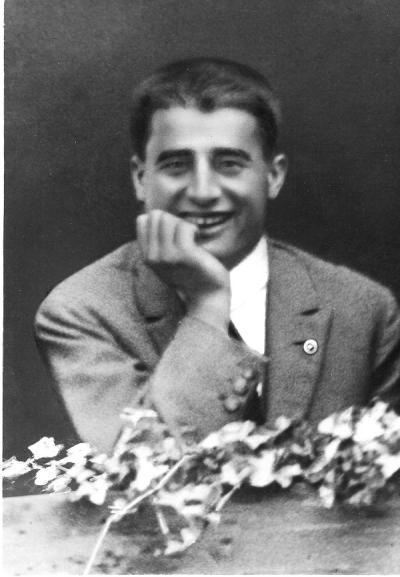
Pier Giorgio Frassati was born in Turin on April 6, 1901. He was the son of Alfredo, founder and editor of the newspaper "La Stampa," and Adelaide Ametis, a woman of strong character and artistic temperament. He had a sister, Luciana, a year younger than him, an inseparable playmate and study companion. His family, an upper-middle-class, liberal one, included an agnostic father and a strictly religious mother, from whom Pier Giorgio received the rudiments of a faith that unexpectedly matured within him and became the foundation of his life.
He attended the Massimo d'Azeglio public school and then, after failing Latin, the Jesuit "Istituto Sociale." Here he began receiving daily Communion, something he would do for the rest of his life, and joined the Saint Vincent de Paul Conferences. In 1918, he enrolled at the Polytechnic University of Turin: he wanted to become a mining engineer "to be able to serve Christ even more among the miners." He joined the "Cesare Balbo" club of the FUCI (Italian Federation of Catholic University Students), which became a privileged place of Christian formation and friendship. He wore the badge of the Catholic Youth in his lapel, adopting its motto: Prayer, Action, Sacrifice.
His deep faith is nourished by daily Eucharist, prayer, frequent confession. He is in love with the Word of God: in his time it is reserved for consecrated people, but he procures the texts to read them personally. Trusting totally in the words of Jesus, he sees the presence of God in his neighbor, he considers himself "poor like all the poor": he is generous with words and gestures of fraternal charity, both alone and in the organized form of the Conferences of Saint Vincent, on the streets of Turin, in the poor neighborhoods, at Cottolengo. In the strong tensions of the first post-war period he is involved in a social apostolate, which sees him present even in the factories. Convinced of the need for social reforms, in 1920 he joins the Italian Popular Party which he sees as a means to create a more just society.
In 1920 his father was appointed ambassador to Germany. In Berlin Pier Giorgio visited the poorest neighborhoods and came into contact with the circles of young German Catholic students and workers. In September 1921 in Rome, during a large demonstration of the Catholic Youth, he defended the flag of his circle from the assault of the royal guards and was arrested.
The writings of Saint Catherine of Siena and the fiery speeches of Savonarola led him to enter the Third Dominican Order in 1922 with the name of "fra Girolamo". He was a member of numerous ecclesiastical associations, in which he poured out the many interests of his Christian life. Son of the director of "La Stampa", he worked as a propagandist for Catholic newspapers.
Since before Mussolini's rise to power, he has been openly against fascism. He is deeply disappointed by the entry of part of the Popular Party into the fascist government, towards which he has very harsh words.
He is passionate about mountains and sports, a member of the CAI and Giovane Montagna. He often organizes trips with friends (the «Shady Guys») that become occasions for apostolate. He goes to the theater, the opera, visits museums, loves painting and music, knows entire passages of Dante by heart.
His capacity for caring for the needs of others was limitless, especially the poor and the sick, to whom he gave his time, energy, and life itself. Two months before graduation, his exuberant youth was cut short by fulminant polio, likely contracted while caring for the poor. He died in Turin on July 4, 1925. Two days later, the overflowing crowd at his funeral began to reveal to his family and the world the greatness of his Christian witness. Thus began the long journey that would lead to his beatification on May 20, 1990, by Saint John Paul II, and his canonization on September 7, 2025, by Pope Leo XIV.